
How Much Does Possession Really Matter?
An analysis of 3,503 matches across five European leagues explores how possession relates to xG, chance creation and actual match outcomes.

An analysis of 3,503 matches across five European leagues shows that possession is clearly associated with chance creation. Its relationship with the final outcome is far less straightforward.
Possession is one of the most visible statistics in football.
It appears in almost every match graphic and is regularly used to describe control, dominance and the overall balance of a game.
But how much does possession actually tell us about performance?
We analysed 3,503 matches from the Premier League, Bundesliga, 2. Bundesliga, Serie A and La Liga across the 2024/25 and 2025/26 seasons to explore how possession relates to underlying performance and match outcomes.
More possession tends to come with a better xG balance
The first question is simple.
When one team has more of the ball than its opponent, does it also tend to create the better chances?
Across the full sample, the relationship between possession difference and xG difference has a Spearman correlation of ρ = 0.398.
Spearman ρ measures whether higher values of one variable generally occur alongside higher values of another. A value close to 1 indicates a strong positive relationship, while a value close to 0 indicates little systematic relationship.
A value of 0.398 therefore points to a moderate positive association.
Teams with a larger possession advantage tend to have a better xG balance, but possession alone does not determine the quality of a team’s attacking performance.
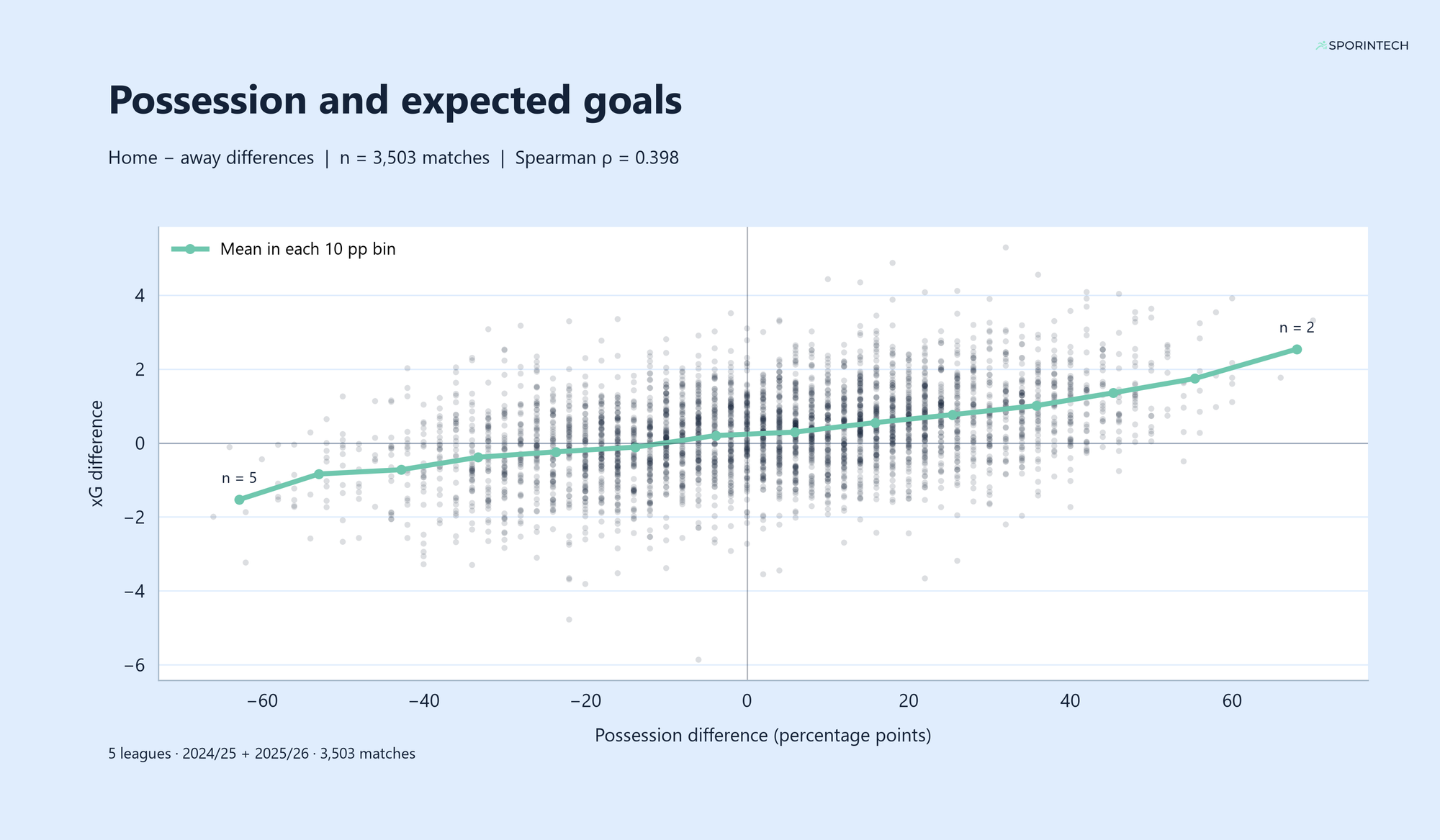
The scatter plot illustrates this clearly.
The average trend rises with possession advantage, but individual matches are spread widely around that trend. Two teams can therefore record similar possession figures and still produce very different attacking performances.
Possession contains useful information, but it is far from the whole story.
More possession, more chances, but only a modest points advantage
The relationship becomes particularly interesting when team performances are divided into possession groups.
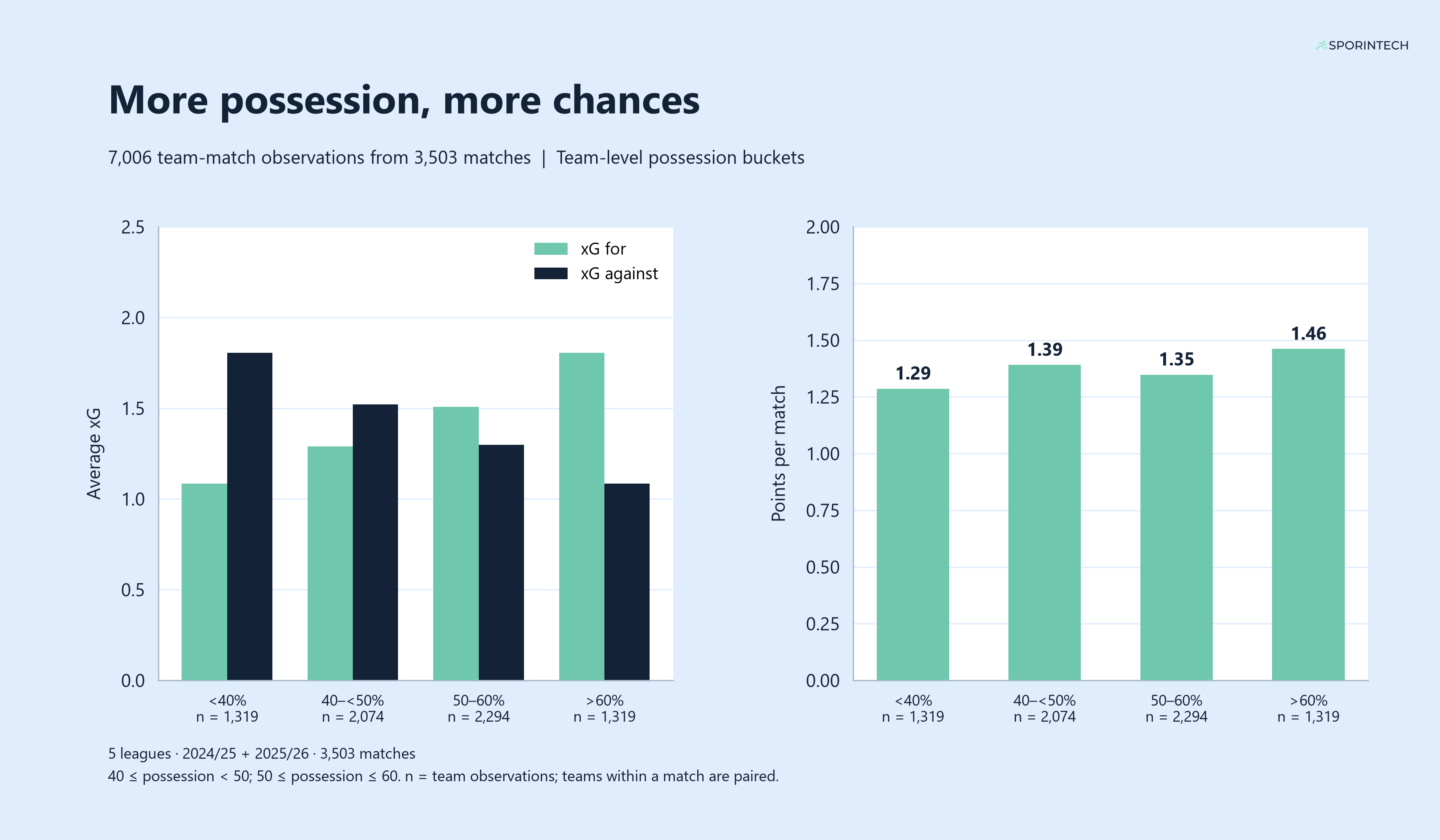
Teams with less than 40 percent possession generated an average of 1.086 xG while conceding 1.806 xG.
Teams with more than 60 percent possession show almost the opposite profile. They generated 1.806 xG and allowed 1.086 xG.
That is a considerable difference in underlying performance.
The difference in actual points is much smaller.
Teams below 40 percent possession averaged 1.29 points per match. Teams above 60 percent averaged 1.46.
The middle categories are not even perfectly ordered. Teams with 40 to 50 percent possession averaged 1.39 points, compared with 1.35 for teams between 50 and 60 percent.
The chart below illustrates the contrast between the xG balance and the points actually won.
This is one of the most interesting findings in the dataset.
Higher possession is associated with a clearly better xG balance, yet the difference in average points won is much smaller.
The relationship differs considerably between leagues
The relationship between possession and xG appears to differ across competitions.
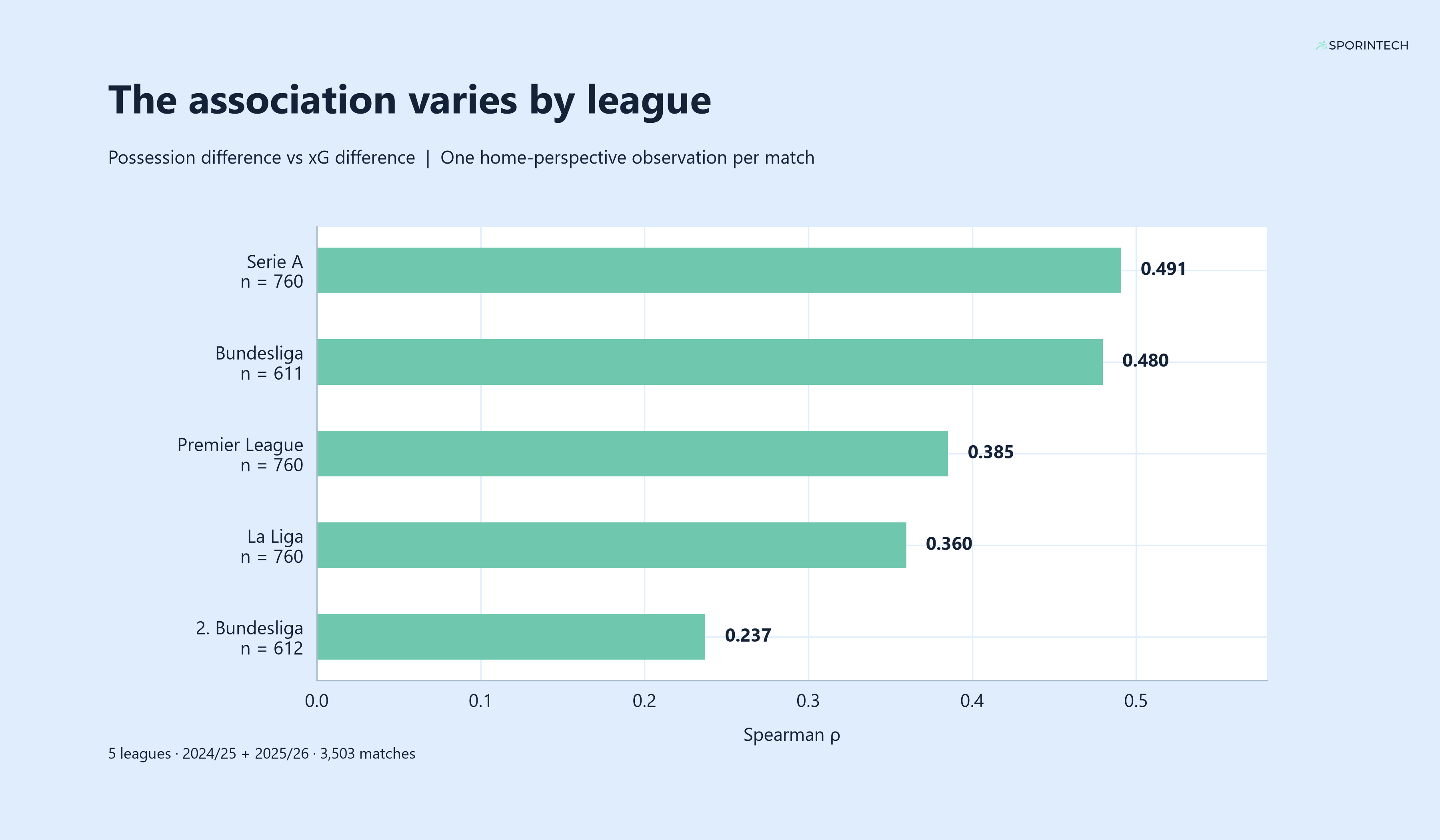
The strongest relationship between possession difference and xG difference in our sample is found in Serie A with ρ = 0.491, followed closely by the Bundesliga with 0.480.
The relationship is weaker in the Premier League at 0.385 and La Liga at 0.360.
In the 2. Bundesliga it drops to 0.237.
Figure 3 illustrates how the strength of this relationship varies across the five leagues.
Competitive balance, tactical approaches, team quality and different game situations may all play a role.
The data shows that the relationship between possession and xG varies across competitions.
Shots tell a different story from goals and points
The comparison between the two seasons adds another important layer.
In both seasons, possession difference is most closely associated with shot difference.
The Spearman correlation is 0.568 in 2024/25 and 0.548 in 2025/26.
The relationship with xG difference is also clearly positive at 0.425 and 0.373.
Once we move to goals, however, the association becomes much weaker. The values fall to 0.084 and 0.043.
For actual points difference, they are only 0.041 and minus 0.003.
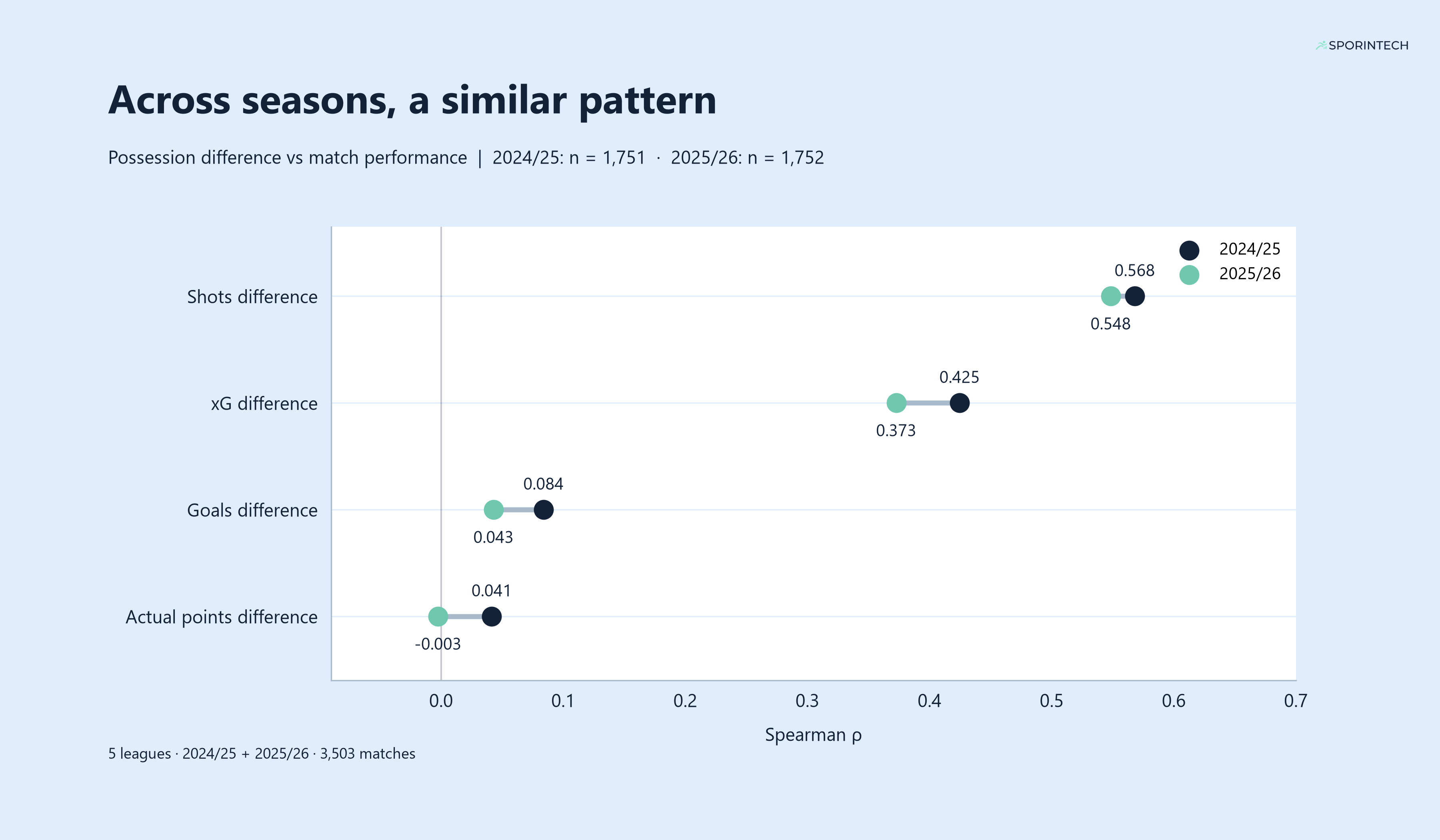
The broad picture is therefore remarkably consistent.
Possession is much more closely related to the process of generating attacking opportunities than to the final result of the match.
The difference between the two seasons should be treated descriptively. The analysis does not test whether these changes between seasons are statistically significant.
So, how important is possession?
The results suggest that possession is useful, but its meaning depends on what we want to measure.
If the question is whether a team is generating more attacking activity and a stronger xG balance, possession provides meaningful information.
If the question is whether that team will actually win the match or collect more points, possession alone tells us much less.
Across the full dataset, possession difference has a correlation of 0.558 with shot difference and 0.398 with xG difference, but only 0.063 with goal difference and 0.019 with actual points difference.
That distinction is important.
Possession describes an element of control. It does not describe everything a team does with the ball, the quality of its finishing or how the match develops after the score changes.
This analysis describes associations rather than causal effects. Match state, team strength, red cards, home advantage and tactical decisions can influence both possession and performance.
Across 3,503 matches, more possession generally accompanies more shots and a better xG balance. When the focus shifts to goals and points, however, the relationship becomes much weaker.