
The Mourinho Effect: Has Real Madrid Changed?
A data-driven comparison of Real Madrid's first eight La Liga matches under José Mourinho, Xabi Alonso and Carlo Ancelotti.

José Mourinho's return to Real Madrid raises an intriguing question: has the team's playing identity really changed, or are we simply seeing familiar strengths under a different manager?
Football discussions often focus on results, formations and individual performances. But changes in playing style can also be examined through measurable patterns: how much possession a team has, how frequently it passes, what kinds of chances it creates and how much it allows defensively.
For this analysis, we compare Real Madrid's first eight La Liga matches across three consecutive seasons:
- 2024/25: Carlo Ancelotti
- 2025/26: Xabi Alonso
- 2026/27: José Mourinho
The aim is to examine whether Real Madrid's early-season performance profile has changed and how these differences can be interpreted.
1. Sporting Outcomes: Different Approaches, Similar Results?
Before examining playing style, it is worth looking at the results.
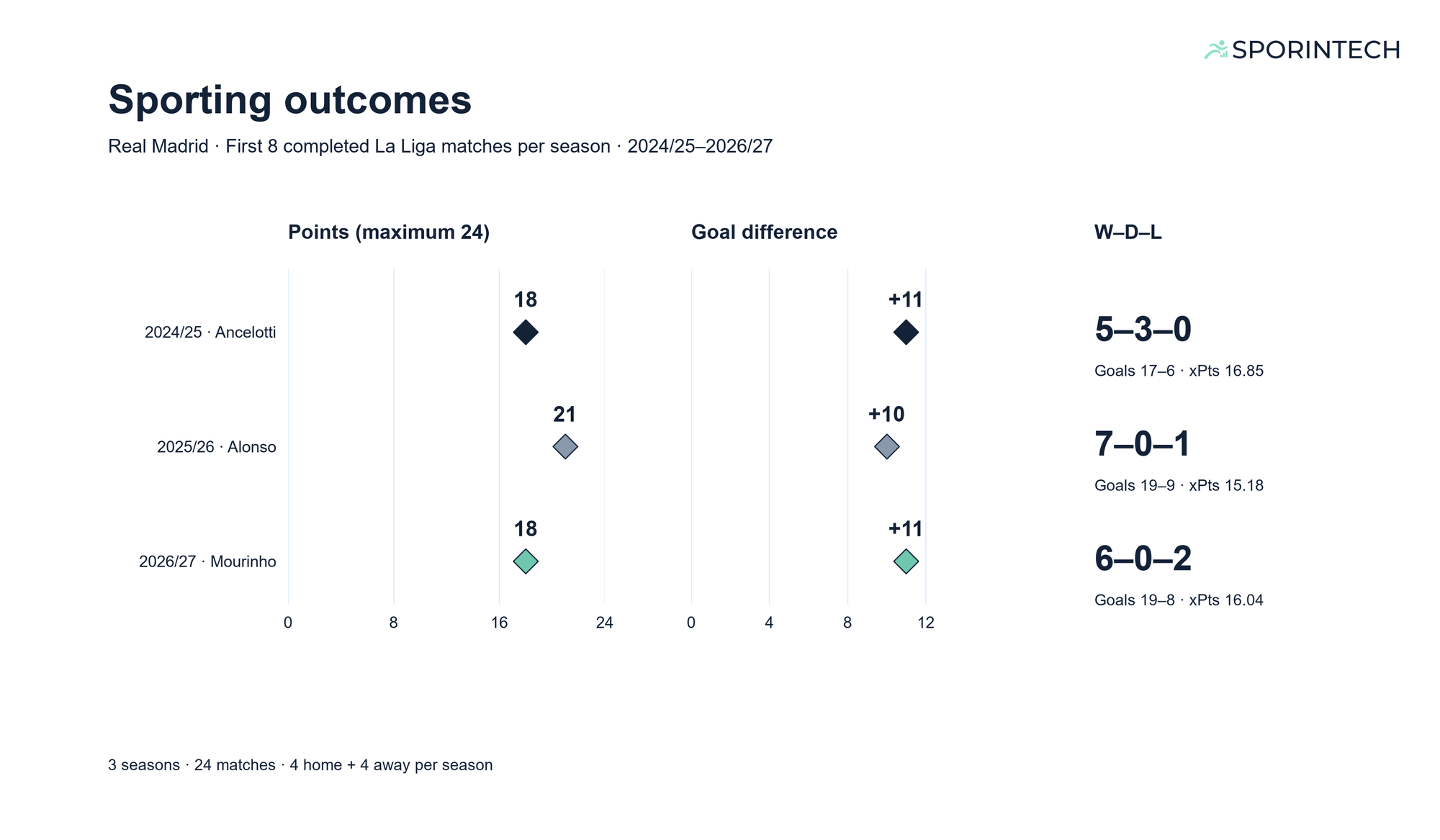
After eight matches, Real Madrid collected 18 points under Mourinho, matching Ancelotti's total in 2024/25 but falling three points short of Alonso's 21 in 2025/26.
However, the paths to those totals were different.
Under Ancelotti, Madrid remained unbeaten with five wins and three draws. Alonso's side recorded seven wins and one defeat, while Mourinho's team registered six wins and two losses.
Mourinho and Ancelotti both achieved a goal difference of +11, despite their different results. Mourinho's team scored 19 goals and conceded 8, compared with 17 scored and 6 conceded under Ancelotti.
Expected points (xPts, an estimate of how many points a team could be expected to earn based on the quality of chances created and conceded) offer another perspective.
Alonso's team collected 21 actual points against 15.18 xPts, a difference of +5.82. Mourinho recorded 18 points against 16.04 xPts, while Ancelotti's team achieved 18 against 16.85.
The early results therefore provide no clear evidence that Madrid has become more successful under Mourinho. But has the way the team plays changed?
2. Playing Identity: A Clear Shift in Possession and Passing
The most striking differences appear in Real Madrid's use of the ball.
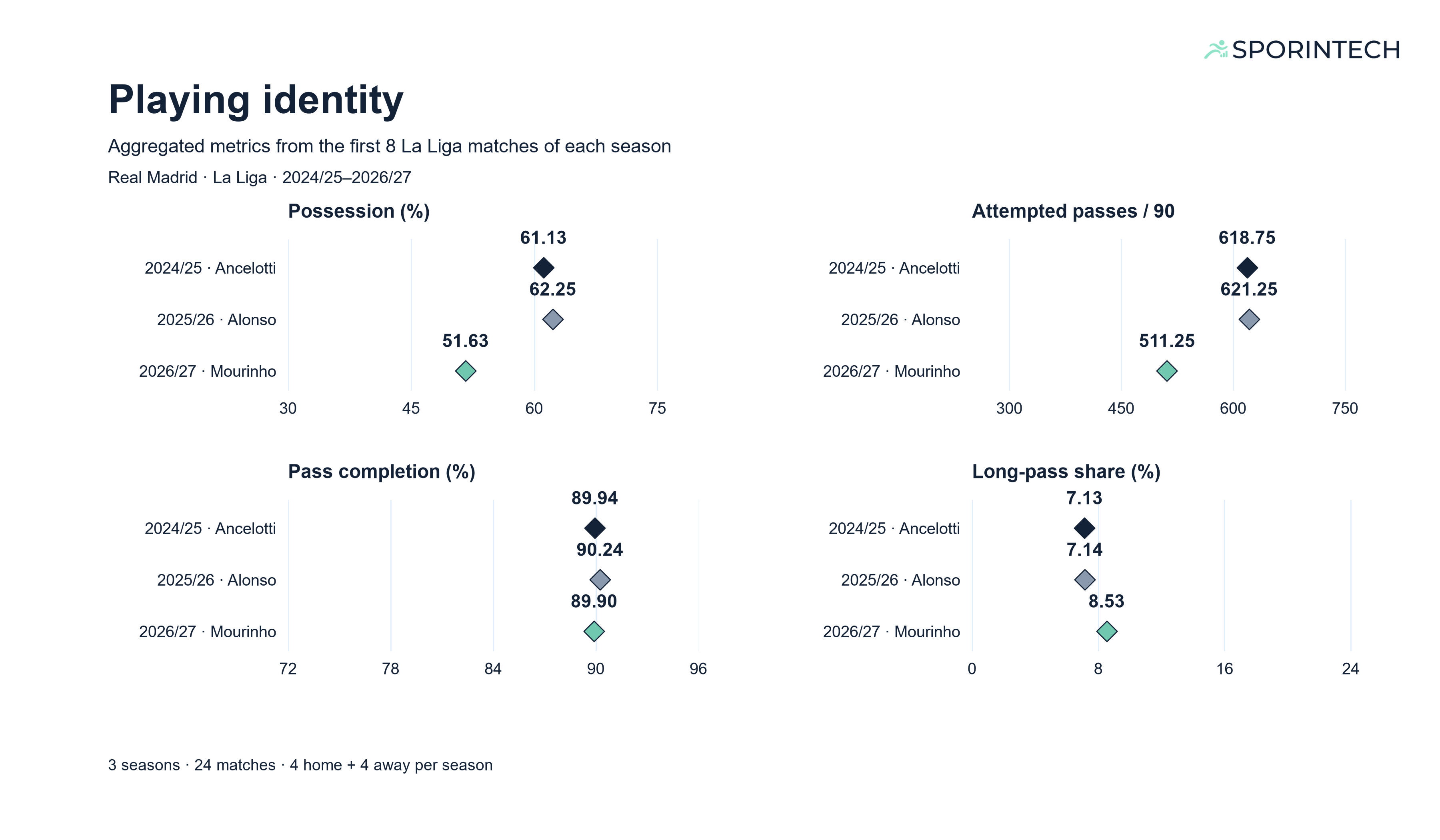
Under Ancelotti, Madrid averaged 61.13% possession in the first 8 La Liga matches. Under Alonso, that figure increased slightly to 62.25%.
Under Mourinho, it falls to just 51.63%.
That is a reduction of more than ten percentage points compared with Alonso's opening eight matches.
Passing volume follows a similar pattern. Madrid attempted approximately 619 passes per 90 minutes under Ancelotti and 621 under Alonso, compared with just 511 under Mourinho.
Yet passing accuracy has barely changed.
All three samples show completion rates close to 90%, suggesting that the reduction in passing volume has not been accompanied by a comparable decline in overall pass completion.
The proportion of long passes also increases to 8.53%, compared with approximately 7.1% in both earlier seasons. This mainly reflects the lower overall passing volume, as the number of long passes remains relatively stable at around 44 per match.
Taken together, these indicators suggest a different approach to ball usage, potentially involving more selective possession and changes in how Madrid builds its attacks.
3. Chance Creation: Less Possession, But Not Less Threat
Lower possession often raises a natural question: does a team sacrifice attacking opportunities when it spends less time on the ball?
Real Madrid's early-season numbers suggest that this is not necessarily the case.
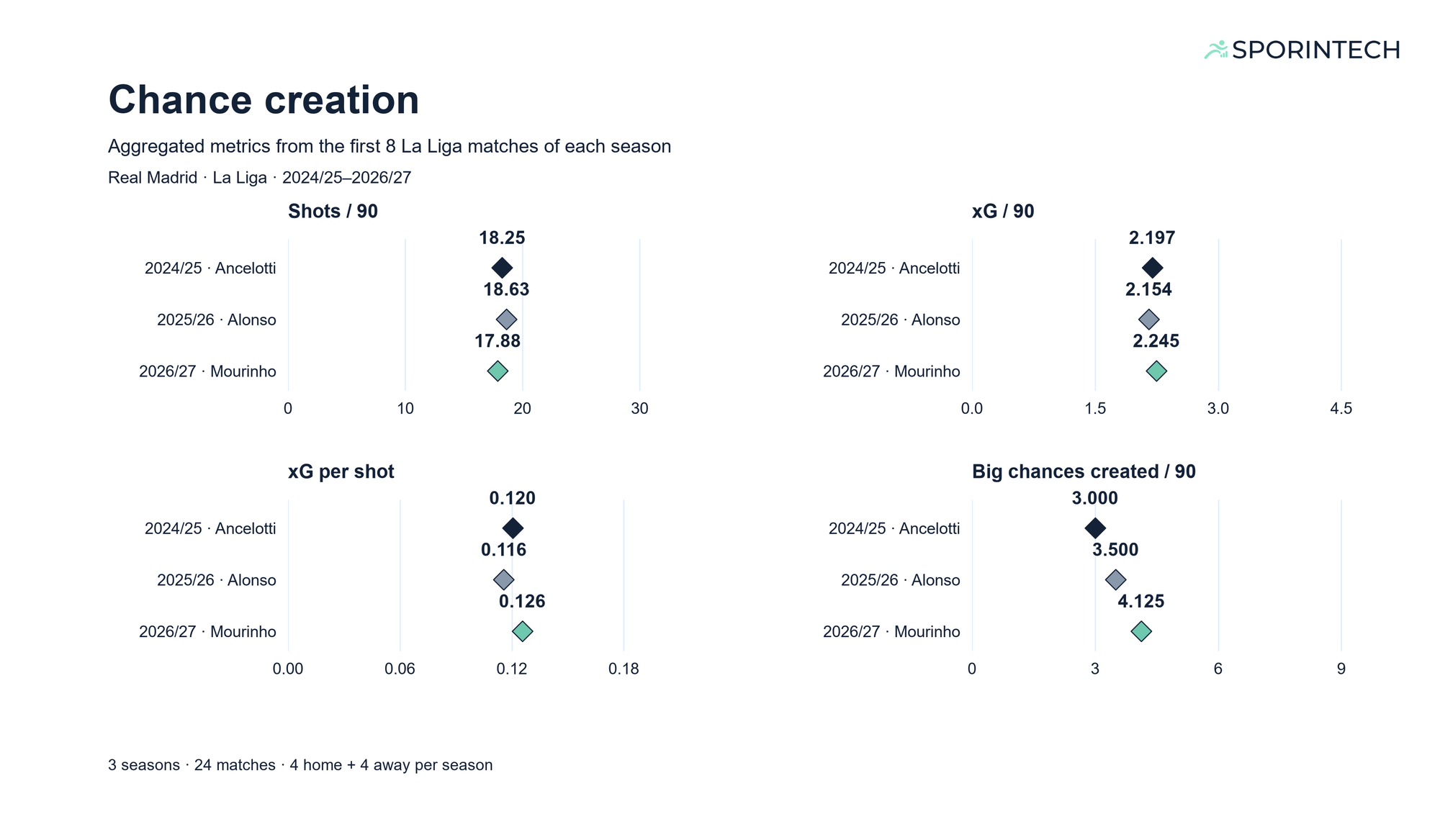
Under Mourinho, Madrid averages 17.88 shots per 90 minutes, slightly below Ancelotti's 18.25 and Alonso's 18.63.
Despite this, expected goals remain remarkably similar across the three periods:
- Ancelotti: 2.197 xG per 90
- Alonso: 2.154 xG per 90
- Mourinho: 2.245 xG per 90
The average expected goal value per shot also increases slightly to 0.126 under Mourinho, compared with 0.120 under Ancelotti and 0.116 under Alonso.
This suggests that the average shot in the latest sample carries a somewhat higher modelled scoring probability.
The number of big chances created reinforces that observation. Mourinho's Madrid generates 4.13 big chances per 90 minutes, compared with 3.50 under Alonso and 3.00 under Ancelotti.
The key observation is that Madrid's substantial reduction in possession has not been accompanied by a corresponding decline in overall chance production.
The slightly higher xG per shot and the increased number of big chances suggest a potentially more selective approach to creating scoring opportunities.
4. Defensive Stability: Has Mourinho Made Madrid More Secure?
Mourinho is often associated with defensive organisation, making this an especially interesting area to examine.
But the data reveal a more mixed picture.
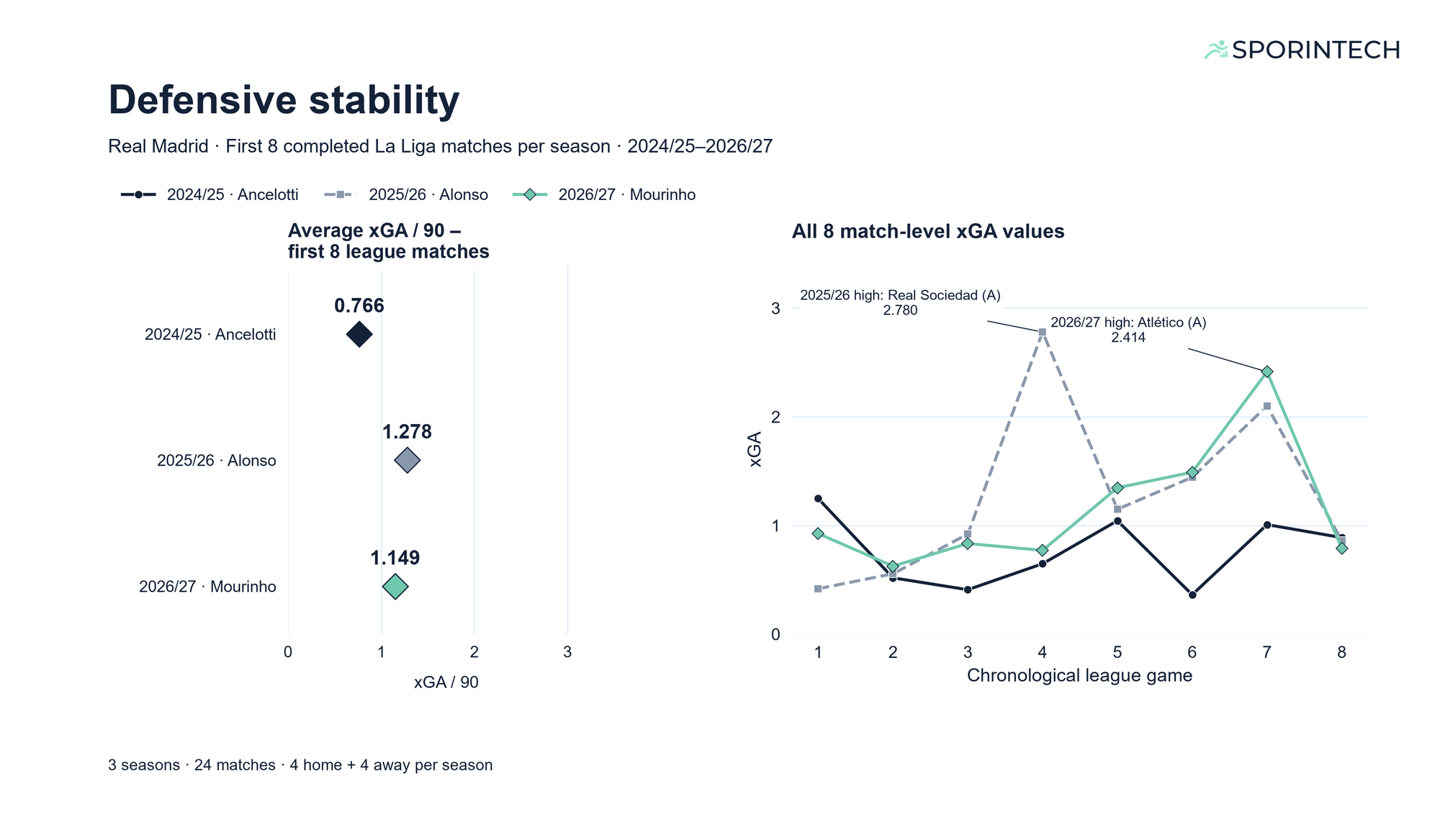
Under Ancelotti, Madrid conceded an average of just 0.766 xGA per 90 minutes.
That figure rises to 1.278 under Alonso before declining to 1.149 under Mourinho.
The current sample therefore shows an improvement compared with Alonso's opening eight games, but not compared with Ancelotti's.
Individual matches also reveal meaningful variation.
Against Atlético Madrid, Mourinho's side conceded 2.414 xGA, the highest value in its eight-game sample. Real Madrid also received a red card in that match, which may have contributed to the unusually high xGA.
Similarly, Alonso's highest defensive xGA value came against Real Sociedad, at 2.780.
These individual examples demonstrate why averages alone cannot fully describe defensive stability.
5. Conclusion: Is There a Mourinho Effect?
After eight La Liga matches, Real Madrid shows a different performance profile under Mourinho.
The clearest evidence concerns possession and passing: both have decreased considerably compared with the equivalent periods under Ancelotti and Alonso.
At the same time, the team continues to generate a comparable volume of expected goals, with slightly fewer shots but a somewhat higher average chance value.
The defensive picture is less conclusive, while the sporting results place Mourinho level with Ancelotti on points and behind Alonso.
So, has Real Madrid changed?
The early data suggest that Real Madrid's playing profile has changed, particularly in how the team uses the ball. The most striking finding is that Madrid continues to generate comparable attacking opportunities despite significantly lower possession.
Whether this develops into a lasting playing identity remains an open question.
Methodology & Limitations
This analysis examines Real Madrid's first eight completed La Liga matches in each of the 2024/25, 2025/26 and 2026/27 seasons, using match and performance data available as of 16 October 2026. Each sample includes four home and four away matches.
Possession is calculated as the average of the eight match percentages. Per-90 figures represent aggregated match statistics divided by eight 90-minute match equivalents. Pass completion, long-pass share and xG per shot are calculated as ratios of the corresponding totals, rather than simple averages of individual-match values.
The comparison is descriptive. The opponents differ between seasons, and factors such as squad composition, match situations, dismissals and opposition strength have not been fully controlled.
Consequently, the findings identify observable differences between the three periods but do not demonstrate a causal coaching effect or establish whether the patterns will persist throughout the season.